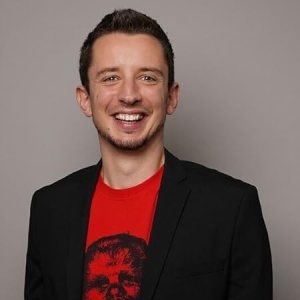
Today on our blog, we are thrilled to welcome Joshua T. Calvert, an award-winning author whose novels have captivated readers across the globe. With over two million copies sold and translations in five languages, Joshua’s work has earned him a place on the USA Today bestseller list and a reputation as a master storyteller. Beyond the page, he’s a frequent speaker at universities, book fairs, and symposiums, where he shares his insights on writing and the art of worldbuilding. Let’s get started!
You’ve successfully published in seven languages, taking the risk of going into secondary markets into your own hands. What inspired you to make that leap, and how has the experience been so far?
I have been fortunate enough to sell quite a few books, and while I’m neither frugal nor stingy, I’m also not keen on wasting money. So I said to myself: Why not invest in your own books by making them accessible to different cultures and readerships? It’s been working out great so far, and I’m very grateful for that.
Germany is your second biggest market. In your opinion, what makes the German sci-fi market unique or different from the English-speaking one?
The covers are different—less pulpy or trashy, if you ask me. The descriptions also differ: they’re longer and give more information about the story you can expect. Another big difference is that the reviews tend to be friendlier in tone and more positive overall. And nobody seems to care about blurbs from big-name authors.
Have you noticed any particular trends in sci-fi literature—either in the US or internationally—that excite or concern you?
Not really. Perhaps there are more dystopian stories, which would be reflective of the times we live in. That is indeed a bit concerning, as we need utopian stories now more than ever to give us a bright future to work toward.
How do you think your work fits into or stands apart from these trends?
I’ve written lots of dystopian books, but over the last year or so I’ve tried to be more optimistic and focus on international cooperation and honorable characters. We need more of both in reality—so why not start with sci-fi?
Do you feel sci-fi has a responsibility to comment on current social or technological issues?
I don’t believe in imposing responsibilities on authors and their works. But I do think it’s at the core of the genre to look at today’s society and technology and project a possible trajectory for both—each influencing the other—into a future that is either realistic or at least internally believable.
What authors or books (sci-fi or otherwise) have influenced your writing the most?
Peter F. Hamilton and Tad Williams.
What challenges have you faced in publishing or marketing your books internationally? Any lessons for small presses or indie authors?
Make sure you get good translations. Stay away from AI, and don’t lose yourself in spending too much money on ads or trying to force a book to be a success. More often than not, the best marketing strategy is simply to write the next book.
What areas of scientific developments interest you most?
AI out of fear, rockets out of awe, biotech out of selfishness.
Books and Characters
Your novel The Object has gained great international with publishers picking it up in the US, Italy and Russia. What was the spark behind that story?
I looked at a mayfly and thought about the subjectivity of our sense of time. We might assume that living for just a single day must feel like a brief blip, but for a mayfly it could be a long life—its faster metabolism, rapid movements, and ability to perceive many more images per second shaping its experience. Then I thought about ghost sharks and Greenland sharks, which can live for hundreds of years. How might they perceive a lifespan many times longer than ours? Are their thoughts slower too, in pace with their metabolism? And then I wondered: if we encountered aliens that lived far longer, with thoughts stretched out over vast spans of time, would we even recognize them as intelligent?
Are there any characters or series you’ve written that you feel especially connected to? Why?

The Fossil was my breakout series internationally, so it will always have a special place in my heart. But number one has to be the Ganymede trilogy, because the characters are a one-to-one representation of our Shadowrun pen-and-paper group—and Theodore is my character. I had such a blast writing those books and bringing our team to life.
Can you share a memorable moment or scene from your writing that sticks with you?
Yes – for Singularity (coming in 2026) I had to use a pinboard covered with pictures and notes, all connected by red lines, just so I wouldn’t lose track of my immensely complex plot. It must have looked like the living room of a psychopath.
For readers new to your books, which title or series would you recommend they start with, and why?

The Object. I think it’s one of my best and most mature stories, alongside Singularity,which I consider the best book I have ever written.
Sci-fi often explores big questions about humanity, technology, and the future. Are there particular themes or messages you hope readers take away from your work?
Yes: Technology is interesting, but the most fascinating thing—the one that should fill us with wonder and make us want to dwell on it—is our consciousness. It eludes all sciences, yet it is undeniably real and has a depth we can explore with nothing other than consciousness itself. Isn’t it amazing that we can think about ourselves and the universe—and even have feelings about those thoughts? Another thing that never ceases to amaze me is the question: Who am I? Like any other question, it appears as a voice in my head. But if there is a voice in my head that I can hear, then I cannot be that voice—so I can’t be my thoughts. Then who is having those thoughts?
Writing
Your novels show a strong foundation in scientific detail. How do you approach research for your stories?
I focus only on what I need for my story. As a master procrastinator by default, I had to learn to focus on what’s important so I wouldn’t get lost in the details. Just to paint you a picture: the quickest way for me to lose an entire working day is to open the Warhammer 40k wiki Lexicanum “just to look up one thing.” I’ll click on every single link in that article. So I try to work out a clear roadmap of what I need to know for my novel before I start writing.
What does a typical writing day look like for you? Do you have any rituals or routines that help you stay focused and inspired?
During the plotting phase—usually about a week—it’s rather chaotic. I just sit and stare at the ocean, the forest, or even the carpet, lost in deep thought. From time to time, I jot down notes, and so on. In the writing phase, I work in bursts of two hours, twice a day—no distractions, no procrastination.
Sci-fi writing often involves balancing imaginative storytelling with plausible science. How do you strike that balance?
I try to outline a scenario rooted in hard science, and then present the reader with a situation or phenomenon that requires only a small leap from that point to the one I want to reach.
What advice would you give to aspiring sci-fi authors trying to break into the market?
Know your target audience. If you want to sell a lot of books, you need to know who your readers are. Remember: you write for them first and for yourself second. Paradoxically, that’s where joy lies. I’ve seen too many authors think they’re writing only for themselves and for the pleasure of the process—but guess what: your readers are part of that process. It starts with the very first line and ends with them closing the book, having had a good time. Keep that in mind.
Have you collaborated with other authors, editors, or scientists during your career? What’s been the most rewarding part of those collaborations?
I’ve worked with Douglas E. Richards (what a great guy!), Ralph Eden, and Brandon Q. Morris. Each time it was a pleasure, and I learned a lot from their way of thinking and their craft. I always try to stay humble and remind myself that my craft can always be improved—as long as I stay open to criticism and to different ways of looking at things.
How important do you think it is for sci-fi writers to engage with their fan communities?
This one might surprise you: not really important. Sci-fi readers are statistically older than in other genres, the audience is male-dominated, and they tend to be less engaged with social media. I especially appreciate that last part, because while I enjoy answering my readers’ emails (I get about 50 per week), I strongly dislike social media. I believe social media algorithms have been the beginning of the AI apocalypse—engagement algorithms that have eroded the glue of our societies: the belief in a common truth and the ability to have a well-mannered, real conversation about things, ideas, and opinions.
What’s the best piece of writing advice you’ve ever received?
Simplify your dialog tags.
Personal Questions
What’s your favorite robot/artificial character?

HK-47 from Knights of the Old Republic (yes, I am that old)
How do you balance writing with other professional or personal commitments?
By remembering that I have to enjoy life at the only time that truly exists: now. There is no past and no future. The past was once a “now” and is now gone, and the future will one day be a “now.” So I try to focus on what I enjoy here and now, and on what feels right. I’m very fortunate to be successful, to be able to write and publish at the pace I enjoy, and to write what I love—and I’m grateful for that in every “now.”
Outside of writing, you have diverse interests like skydiving and martial arts. How do these hobbies influence your writing, if at all?
I have a certain level of fearlessness and I’m drawn to extraordinary experiences, which is something you can probably see in the characters I write. Mostly, it’s a fearlessness toward psychological challenges—something I long to have, but so far only possess on a physical level. It’s something I’ve been working on for quite a while now. My characters go through that process in a shorter timeframe, but almost all my stories are about personal resilience and a transpersonal view of life and the universe.
What’s something about you that fans might find surprising?
I’m a huge ABBA fan, and while I’ll happily jump out of planes, I’m afraid of spiders. And I’m terrible with tech—pretty much the opposite of an early adopter.
If you could spend a day in the world of any sci-fi book (including your own!), which would it be and why?
It’d be The Object. The idea of receiving alien thoughts in my conscious dreams is fascinating to me.
If you weren’t a writer, what career do you think you’d be pursuing?
Easy answer: I’d be the pilot of a rescue helicopter!
What’s your go-to “comfort” book or movie when you want to relax?
A New Earth by Eckhart Tolle.
Our sincere thanks to Joshua T. Calvert for this engaging interview and for offering a glimpse into the mind behind his remarkable stories. Thanks and best wishes for the future! 🙂

 Starry Eyed Press