
Starry Eyed’s latest release collects a variety of science fiction stand-alone tales set in the expansive 224-Verse. Among the pieces included is a duology of western-themed space operas from first-time 224-Verse contributor Anthony Perconti.

We took a moment to sit down with the author to gain some insight on his development process and inspirations.
Anthony, can you tell us a bit about yourself and how you became involved with Starry Eyed Press and the 224-Verse?
Thanks for the opportunity! I am a terminal nerd, who lives in New Jersey with my wife and kids. I became involved with Starry Eyed Press by submitting a drabble (“Red Sun Blues”) to the First Contact anthology. Around that time, I also picked up Bountiful Pursuits, by Jason Russell. That was my first exposure to the 224-Verse and the open world ethos. The rest as they say, is history.

Your contribution, Lawmen Duology, adds a western flair to the space opera setting. What inspired you to blend these two genres?
What inspired me, was my love of the subgenre. Space western’s have been around for nearly a century, as far as I can tell. You can point to C.L. Moore’s Northwest Smith as an early standard bearer. Smith is a classic outlaw. He exists in an ‘old solar system’ model, where eldritch horrors lurk on every planet. Then you have Leigh Brackett’s sell-sword & guerilla fighter Eric John Stark (think John Carter of Mars by way of Dashiell Hammett). In the 1980’s, Mike Resnick authored Santiago: A Myth of the Far Future. And today, we have such works as Paul McAuley’s “Blade and Bone,” and The Mandalorian. If anyone is interested in checking out space westerns, I would point them to that first episode of The Mandalorian. It encapsulates the subgenre perfectly, in my view.
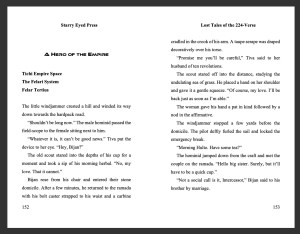
What themes or ideas were you exploring in Sentiment of the Law and A Hero of the Empire?
Jason Russell has a throwaway line in Bountiful Pursuits, that states that the Tichi Empire, is basically one factor removed from being a vast mafia state. That fascinated me. A political, social and military body run as a systemwide kleptocracy. What does it take to become the emperor of that particular hill? What about the regular people living in those conditions? Can justice exist in a system based on the dictum of might makes right?

Who are the main characters in your duology, and what drives them?
Bijan, from “A Hero of the Empire,” is an old frontier scout turned deputy, while Domatia Ago, from “Sentiment of the Law,” is a peacekeeper, with a colorful past. I wanted to write about characters who had strong moral centers, that were living in a system where everything and everyone is up for sale. Like Phillip Marlowe, navigating the mean streets of Los Angeles, I wanted to write about individuals that lived and died by a strict code. Bijan and Domatia are world weary characters, who still show up and do the right thing at days end.
Did you have a favorite moment or scene to write in either story? Why that one?
The confrontation between Domatia and Dolso Tu at the climax of “Sentiment of the Law.” It’s a classic high noon showdown, with swords and lasers!
What’s your go-to writing fuel—coffee, tea, snacks, something stronger?
Heroic amounts of hot coffee, for sure.
Do you write to music? If so, what’s on your current writing playlist?
Never during a writing session-I find it too distracting. I do listen to music before and after though. During the writing of the Lawmen Duology, I was listening to lots of Carpenter Brut. Also the Red Dead Revolver/Redemption soundtracks and the western scores of Ennio Morricone were in constant rotation to get me in the right headspace.
Are you a night owl or early bird when it comes to writing sessions?
I prefer to write in the morning, but given the demands of the day to day, that’s not always in the cards. If I can’t write first thing, then I try to sneak it in whenever the opportunity presents itself. Ten minutes here, half an hour there.
Describe your ideal writing day. Where are you? What’s around you?
My ideal writing day consists of getting up early, putting on the coffee and just getting to it. I prefer to work in silence, so I hole up in our junk-drawer room/ office for a few hours. The room gets some pretty good natural lighting and (surprise!) stacks of books & graphic novels are all around.
Do you have any writing rituals or superstitions before you start a new project?
No superstitions, per se. However I like to read up on genres that I’m attempting to tackle before I dive in. For example, while writing Lawmen, I was dipping into The Complete Western Stories of Elmore Leonard.
What’s one book or author that made you want to become a writer?
That’s a tough one. I grew up reading tons of sci-fi, fantasy and comic books. And as many people do, I varied my reading habits as I grew older. Some of my favorite writers include Michael Moorcock, Joe R. Lansdale, Gene Wolfe, Walter Mosley, Cormac McCarthy, Alan Moore, Grant Morrison, Ursula LeGuin and Jorge Luis Borges. All of those writers wowed me with their mastery of the craft. But if I had to narrow it down to just one book? I would say Borges’ Collected Fictions. Borges could fit so many brilliant ideas in just a handful of pages. His stories are quite short and brimming with intellectual creativity. I never tire of (re)reading him.
If you could spend a day with any fictional character (yours or someone else’s), who would it be and why?
Latro, from Gene Wolfe’s Soldier sequence. As to why, I would say it’s due to his nobility of character, in the face of tragic circumstances.
What’s the best piece of writing advice you’ve ever received—or the worst?
It’s the same piece of advice, that was stated by Joe R Lansdale and Alan Moore. I’m paraphrasing here, but it’s basically just ‘put ass in chair and just write the thing’. The task of cleaning & tightening up the story can come after. Just get it out of your head and onto the page. Constructive criticism and editorial stewardship is also a big help (which Starry Eyed Press provided, for which I’m grateful). Ask people you trust for their honest opinions and feedback, whenever possible.
Finish this sentence: “When I’m not writing, you’ll probably find me…”
“Hanging out with my wife and kids.” Along with, “With my nose stuck in a book. “


 Starry Eyed Press