
Don’t worry, no spoilers 😉
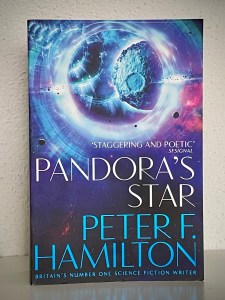
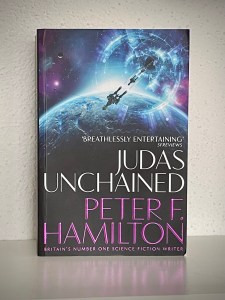
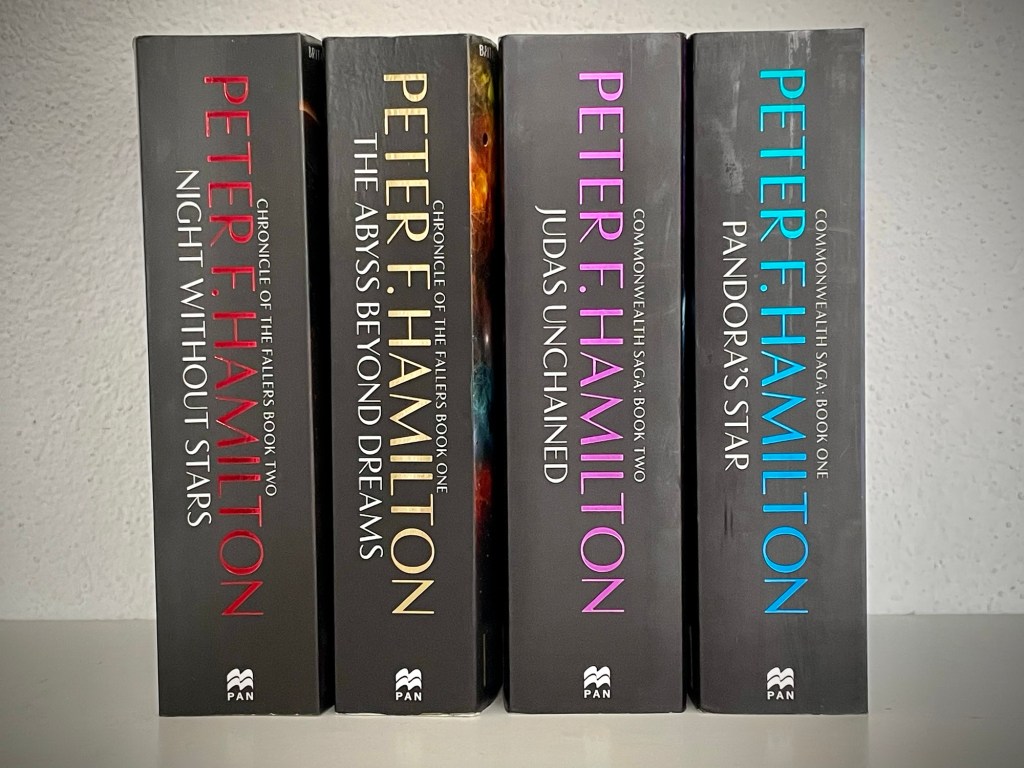
Peter F. Hamilton’s Pandora’s Star and Judas Unchained—together forming The Commonwealth Saga—are monumental works of science fiction. Spanning over 2,000 pages or 78 hours on audio combined, they deliver a richly layered tale of human expansion, alien confrontation, and ideological warfare. This is a future where humanity has seamlessly integrated technology into everyday life, mastered rejuvenation, wormhole travel, and essentially reached immortality—and where the real threats often come not from the stars, but from within.
The Interconnected Commonwealth—and the Mystery Which Shatters It
In the 24th century, humanity has created what for all intents and purposes is a utopian civilization. Through wormhole technology, hundreds of planets are linked in an interstellar web where rejuvenation and memory backups have redefined the concept of mortality. E-Butlers and OCtattoos ensure your access to the most recent data on the unisphere, allow users to experience sensual dramas like never before or get memory implants to learn new skills within minutes. But when astronomer Dudley Bose witnesses the distant star systems Dyson Alpha and Dyson Beta abruptly and inexplicably becoming sealed off from the rest of the galaxy, the Commonwealth feels the need to investigate. Soon, the first interstellar starship Second Chance is built and sent on its maiden voyage—and uncovers something that shakes the foundations of their advanced society.
What begins as a scientific mystery quickly expands into a galaxy-spanning conspiracy with existential stakes. The narrative sprawls across multiple planets, cultures, and timelines, giving us the viewpoints of a wide cast of characters, yet Hamilton’s control of pacing and structure keeps it coherent. Attentive readers with a keen sense for details might pick up on the author’s intricately layered breadcrumbs and foreshadowing, hence making part of the story developments predictable, but the satisfaction lies as much in surprise twists as in watching a complex mystery unravel piece by piece.
A Galaxy Filled to the Brim
The richness of the saga lies not just in its fresh ideas and new technologies, but in the people—and species—who inhabit them. Investigator Paula Myo is one of my favorite characters: genetically engineered for perfect impartiality and obsessive pursuit of justice, she stands out and anchors the moral tension of the story. At the other end of the spectrum. We have Ozzie Fernandez Issacs, an eccentric genius and co-inventor of the wormhole technology, who sets out to explore the alien Silfen Paths in search of further knowledge about the Dyson Envelopment Event. The mysterious interdimensional trails take him on a desperate journey through space, making new friends along the way. Among them, the colorful alien Tochee (another personal favorite who—for no particular reason—reminds me of Terry Prattchet’s The Luggage). The elf-like Silfen themselves bring an ethereal counterpoint to the hard science of the Commonwealth. Their slow, meandering way of life—timeless, poetic, and incomprehensibly alien—adds both charm and philosophical depth to the story. Their paths hint at ancient truths that defy scientific explanation, touching on ideas of myth, time, and the unknowable.
Throughout both books, the different alien species offer a unique perspective on humanity. They provide interesting cultural contrast, showcasing how different civilizations interpret development, justice, loyalty, and diplomacy. Their presence underscores one of the saga’s most powerful themes: coexistence in the face of vast biological and philosophical differences.
Social Norms in the Post-Death Era
One of the saga’s most distinctive features is its candid portrayal of sexuality. In this future, where death is reversible through re-life procedures and aging optional, traditional social boundaries have been reshaped. Casual relationships, fluid identities, and hedonistic lifestyles are the norm—portrayed frequently and with little moral judgment.
Some readers may find this depiction refreshingly honest, a natural extension of the freedoms such a society might allow. Others may feel that it veers into overindulgence or objectification at times. Regardless, it’s an intentional element of Hamilton’s worldbuilding: this is a civilization no longer bound by scarcity or consequence, and its evolution—both technological and cultural—is on full display.
Final Thoughts: A Triumph of Scope and Vision
Pandora’s Star and Judas Unchained are massive in scope and rich in detail, delivering a compelling mix of science fiction spectacle, political tension, crimenal investigations and existential reflection. Though the size and complexity of the books can be daunting, readers who embrace the depth will find a narrative that is both intellectually stimulating and emotionally satisfying.
With its diverse cast of humans and aliens, philosophical undercurrents, and high-stakes intrigue, The Commonwealth Saga proves that science fiction can be both deeply entertaining and thoughtful. Peter F. Hamilton doesn’t just tell a story—he builds a future that feels fully alive.
Rating: 5 of 5 Stars ⭐️⭐️⭐️⭐️⭐️

 Starry Eyed Press